
It is 10:47 AM and a BDR named Priya just got off a call with a VP of Ops at a series-C logistics company. She had prepped for it. She had a hypothesis. She had questions. She was going to run the discovery motion the enablement team spent six weeks building.
She ran none of it.
The VP opened with "I have seven minutes, what does your product do," and Priya's brain reached for the deck she does not have, then for the framework she cannot remember the name of under pressure, then for a version of the elevator pitch that came out of her mouth twenty seconds later while her prefrontal cortex was still buffering. The VP said "got it, thanks, not for us" at minute five and hung up.
Priya closed her laptop. Priya knew what she was supposed to do on that call. Priya did not do any of it. Priya is not going to bring this up in her 1:1 because Priya is 26 and would like to keep the job.
This is not a training problem. Priya has been trained. This is not a knowledge problem. Priya can recite the discovery framework in a role play at 3 PM on a Wednesday with her manager watching. This is an Apply problem, which is a different problem, and it is the exact problem every rep is quietly having every day while everyone assumes the training must have solved it because they built the training.
The gap between knowing and doing under pressure closes in exactly one place. Practice. Not the kind that happens once in onboarding. The kind that gets attached to the work itself, weekly, in a way small enough that a rep will actually do it and specific enough that it produces a behavior instead of a feeling.
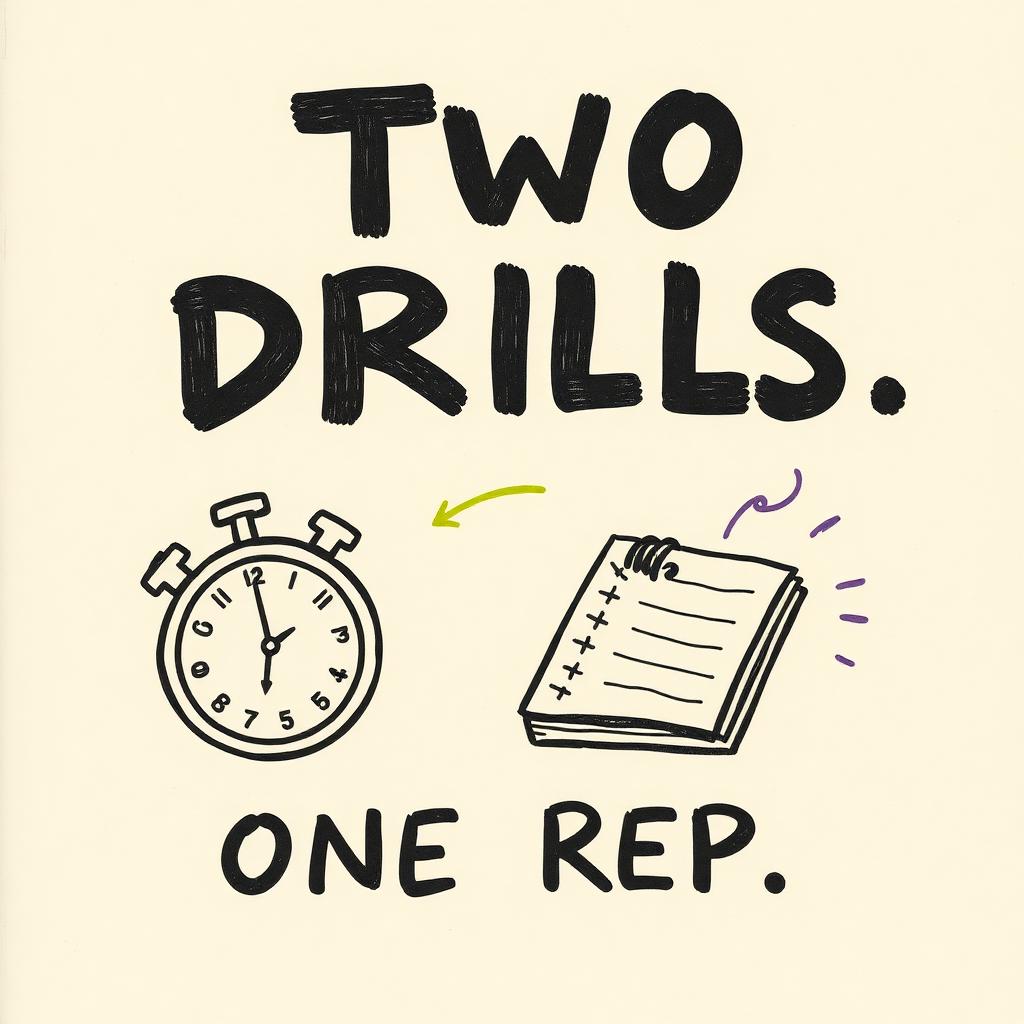
Two drills. Eight minutes total. Attached to every real call worth learning from. That is the whole thing.
Why Two Drills And Not More
Every enablement program tries to teach a rep fourteen things. Every rep, under real pressure with a real buyer, executes maybe two of them. The other twelve exist in the training doc and nowhere else.
The math on behavior change is unforgiving. The number of new habits a human can actually install in a quarter is small. It is somewhere between one and three. Not fourteen. Not the whole rubric. Not "and also start doing MEDDIC." A rep who runs two drills consistently for a quarter will outperform a rep who has been handed nineteen frameworks and no drill attached to any of them. Every time. It is not close.
The two below are chosen for one reason. They are the two moments where knowing turns into doing or does not, and the rep is the only person in the room when it happens. Everything else is downstream of these two moments.
"The rep who practices the skill twenty times before the real call outperforms the rep who learned the skill in a training and went straight to the real call. That second rep is practicing on your pipeline."
Drill One. Five-Minute Pre-Call Rehearsal.
Not "prep." Prep is what a rep does with an open tab and a vague sense that they should probably know something about this account. Rehearsal is different. Rehearsal is verbal, timed, and rehearses the moment the rep is most likely to fumble, out loud, before it is happening in front of a buyer who does not care.
Five minutes. Same shape every time. Attached to every meeting on the calendar with a real buyer, not to "important" ones, because the rep is the least reliable narrator of which call will matter.
The five-minute pre-call drill
Not prep. Rehearsal. Say the words out loud before the buyer is on the line.
One sentence. What is my hypothesis about why this account might care right now.
Not what the company does. Not what they raised. Why now. Say it out loud. If it takes more than one sentence, the hypothesis is not real yet and the rest of the call will suffer for it. Rewrite it in your head until it comes out clean.
Say the opener out loud. Twice.
Not read. Say. The first time will be clunky. That is the point. Better clunky at 10:42 in your headphones than clunky at 10:47 into a VP's ear. The second pass will sound like a person. Ship that one.
Rehearse the three questions you actually want answers to.
Not the fifteen in the discovery template. Three. If the call gets cut to seven minutes, which three do you need. Say them in the order you would ask them. Notice which one you keep tripping over. That is the one to lead with.
Rehearse the moment you know you fumble.
Every rep has one. "What does your product do." "How is this different from [competitor]." "How much does it cost." Pick yours. Say your answer out loud. If the answer is longer than fifteen seconds, cut it. Rehearse the cut version. You now have a real answer instead of a panic monologue.
This is five minutes. The rep who does this before every call has, at the end of one month, rehearsed forty openers, one hundred and twenty questions, and forty versions of the exact moment they used to fumble. That is not a training. That is a rep whose reps compound.
The rep who does not do this has, at the end of one month, done zero of that and is still relying on the framework they learned in onboarding to activate on its own when the pressure hits. It does not activate. That is the whole problem the enablement team is trying to solve from a slide deck.
Drill Two. Three-Minute Post-Call Replay.
Not a Gong review. Not a coaching session. Not something the manager runs. The rep, alone, three minutes, immediately after the call, before the next thing on the calendar makes it disappear. Because the window on this is now, not Thursday when they finally get to it, when "I don't remember exactly what happened" replaces "here is the exact sentence that broke it."
Three questions. Written down. Same three every time. The point is not depth. The point is that a rep who does this fifty times will have a private, honest, longitudinal record of their own pattern that no manager, no LMS, and no call intelligence tool can hand them. Because it is the rep's own read of the rep's own work, and that is the read that changes behavior.
The three-minute post-call drill
Write it down. Immediately. Not later. The read decays fast.
What was the one moment the call turned.
Every call has one. It might be a question that landed. It might be a beat where the buyer said something honest and you didn't dig. Write the sentence. Theirs, not yours. Not "it went well." The actual moment.
What did I do at that moment. What could I have done instead.
Two clauses, one line. "I moved to my next question. I could have asked why it mattered." That is the entire behavioral loop. Doing it once teaches nothing. Doing it fifty times teaches a rep what they do under pressure, which is the thing no training can teach them because no training is there.
One thing I am rehearsing before the next call because of this.
This is what turns the drill from journaling into training. If nothing carries forward into tomorrow's rehearsal, the replay is a diary. It has to feed the pre-call. That is what makes the two drills one system instead of two habits.
How A Manager Defends The Eight Minutes
Someone reading this is a BDR manager thinking "my reps do not have eight minutes." A different someone reading this is that manager's VP thinking "my reps do not have eight minutes." Both of you are wrong and I say that with love.
A rep on 12 dials a day and 3 meetings is spending nine hours in front of a screen. The claim that eight minutes attached to the meetings that matter cannot be found is not a time problem. It is a priority problem. You are prioritizing volume of activity over compounding of skill. The rep who does this outperforms the rep who does not by month three. Every quarter you delay picking that up, you are running the wrong optimization.
Why This Works And Most Enablement Does Not
Both drills share three properties that most training programs do not have. They are attached to the work, not scheduled around it. They are small enough that a real human under real workload will actually do them. And they produce a specific behavior instead of a general feeling that the rep is now "better at discovery."
That is the shape of anything that changes behavior. Attached. Small. Specific. Every training that fails on the pipeline review three months later fails on at least one of those three. Usually all three. The eight-minute answer is not a hack. It is what practice looks like when it is designed to happen instead of designed to be attended.
"Attached to the work. Small enough to actually do. Specific enough to produce a behavior. That is the shape of anything that changes what a rep does under pressure."
Back To Priya
Priya started running the two drills the next Monday. Not because anyone asked her to. Because she read something on a Sunday night and decided she was tired of walking out of calls she could have run better if she had said the words out loud once before the buyer heard them for the first time.
Week one felt stupid. Talking to herself in an empty room felt like she was faking a job she already had. Week two the openers stopped sounding like a recitation. Week three she noticed she was answering "what does your product do" in one clean sentence instead of the ninety-second monologue she used to close with an apology.
In week six she got another VP of Ops on the line. Seven minutes. Same setup as the one that had ended her Priya's week two months ago. This one ended with the VP saying "send me a time next Tuesday, I want my Head of Fulfillment on it." Priya closed her laptop. Priya did not tell her manager. Priya wrote down what she did at the moment the call turned so she could rehearse it tomorrow.
That is the whole compound. Two drills. One rep. A behavior that used to live in a training doc now living in the rep.
Keep going
Read next
Everyone Passed the Training. Nothing Changed.
The enablement-side companion. Why most training never touches Apply, and the one question to ask before the next build.
Free tool
Weekly Coaching Scorecard
The one page a manager runs to check whether the drills are actually happening. Not "did you do the drill." Something better.
Outbound, But Smarter
The Modern BDR Operator
Get the next one in your inbox.
New frameworks, hot takes, and playbooks. Written for operators, not audiences.
Subscribe to Booked.