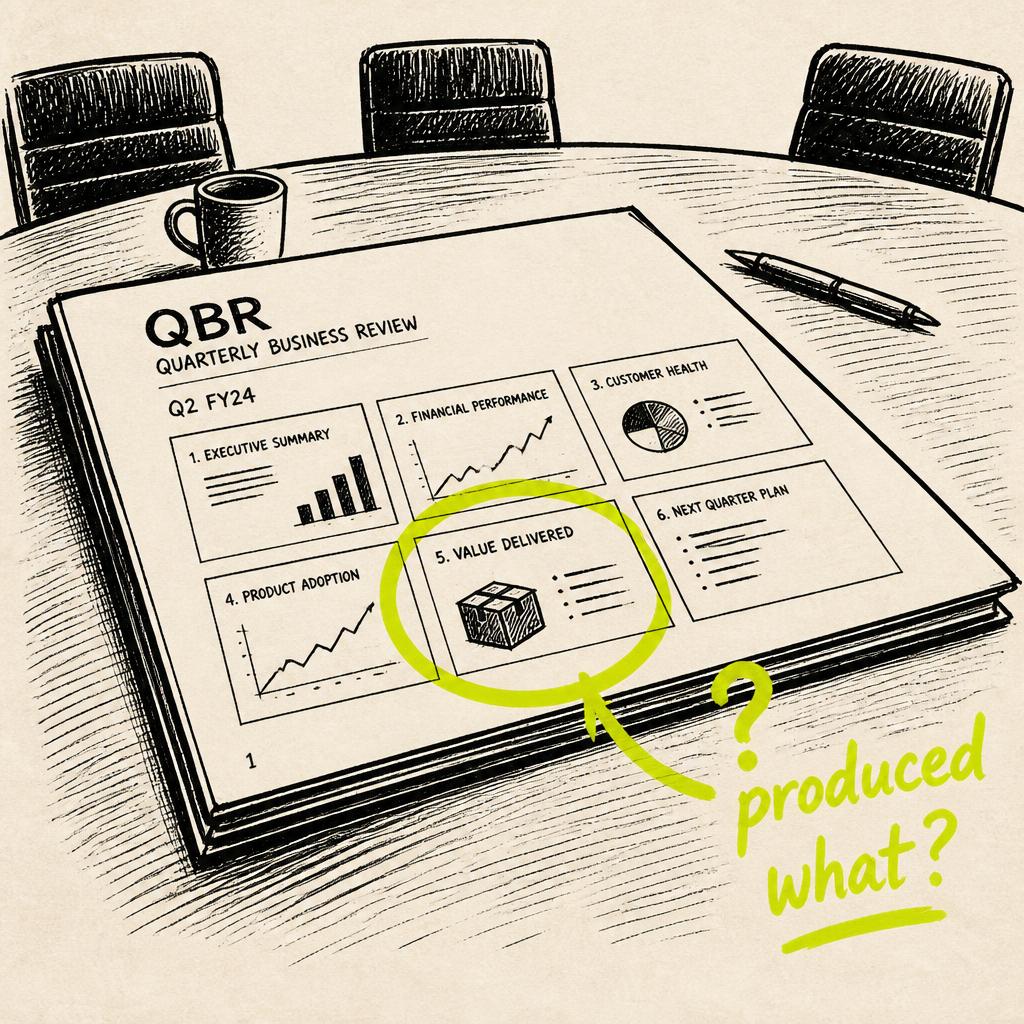
Every GTM enablement leader eventually gets the same question in a QBR. It usually comes from the CRO, it usually comes about ninety seconds into the deck, and it goes exactly like this: what did this produce in pipeline.
I have watched smart, senior enablement people freeze at that question. Not because they were bad at the job. Because the measurement system they inherited was built to track what the enablement team did, not what changed downstream because of it. Completing a training is not delivering revenue. It is clearing a prerequisite. The revenue is in what happens after, which is either being measured somewhere or it isn't. Most of the time, it isn't.
The enablement leaders who can answer that question keep their budget. The ones who can't answer it spend the next quarter building the measurement system they should have built first. This post is that system, plus the global chassis that makes it work across regions, plus the AI governance layer you need before the first tool goes live.
"The enablement team that gets cut in a downturn is the one that presents completion rates to a CRO who is thinking about headcount."
What Gets Measured vs What Actually Matters
The gap between what most enablement functions track and what the business actually needs to know is large enough to lose a budget in. Survey scores tell you whether people liked the training. Completion rates tell you whether they attended. Neither tells you whether anything changed in the field, and field behavior change is the only thing that produces revenue.
What most enablement teams track
- Training completion rate
- Post-training survey score (the smile sheet)
- Seats filled per session
- Content library usage
- Manager 1:1 cadence adherence
- Number of programs launched
- Onboarding milestone completion
What the CRO actually needs to see
- Ramp velocity, time from hire to first qualified meeting
- Meeting-to-opportunity conversion by cohort and manager
- BDR-sourced pipeline as percentage of total qualified pipeline
- AE win rate on BDR-sourced opportunities
- Stage 1 to Stage 2 conversion trend by manager
- BDR-to-AE promotion rate
- AI adoption at behavior level, not login level
The left column is not useless. Completion matters if the skill being trained shows up in the behavior being measured. The problem is that most orgs built the left column first and never connected it to the right column. Activity is easy to track. Revenue impact requires a different infrastructure, built before the programs that are supposed to produce it. Otherwise you are always building the scoreboard after the game ended.
The Global Layer. What Changes When You Are Running Three Regions.
The hardest version of GTM enablement is the global version. Running it for a team in Austin is one thing. Running it for teams in Austin, London, Singapore, and Sydney simultaneously, with different market dynamics, different regulatory environments, different coaching cultures, and a seventeen-hour time zone spread, requires a fundamentally different operating model than a domestic program scaled up.
Two things have to be true at the same time and most global enablement leaders get one of them right. What you standardize has to be identical across every region. What you adapt has to be genuinely local, not a light translation of the North American playbook with different spelling.
Standardize globally
- The revenue measurement framework, same metrics, same definitions
- The qualification standard, what counts as qualified does not vary
- The handoff quality bar, an AE in London gets what an AE in Austin gets
- The coaching cadence structure, weekly, monthly calibration, quarterly review
- AI tooling governance, same tools, same policy, same adoption measurement
- Career path and promotion criteria, a BDR-to-AE bar that does not move by region
Adapt regionally
- Channel mix, email-heavy NOAM, relationship-first EMEA, social and referral-led APAC
- Outreach pacing, EMEA runs slower, APAC needs relationship before direct outreach
- Compliance architecture, GDPR structurally changes what outreach can look like at volume
- Coaching style and feedback approach, direct feedback lands very differently across cultures
- Proof points and ICP, the customers that build credibility are market-specific
- Manager development, a Berlin manager is not developed the same way as a Singapore manager
The EMEA team handed the same cold email sequence the North American team runs is not getting enablement. It is getting a compliance risk and a conversion rate problem dressed up as a playbook. The discovery questions that surface Current State on a cold call in San Francisco need different language in Frankfurt or Singapore, not because the gap is different but because the conversational norms around how you name it are.
Treat the motion as universal and you build an EMEA team that does not trust the playbook, plus an APAC team that quietly runs a different motion than the one being measured because the one being measured does not work in their market. The leader who has done this before knows which decisions belong in the standard and which belong to the region. The one who hasn't finds out during the EMEA QBR when the numbers don't match the global model.
AI at the Function Level. A Philosophy, Not a Tool List.
Every GTM enablement leader is being asked about AI right now. Most of the conversations are about which tools to buy. The more important conversation is what the function is actually trying to do with AI, and what happens when you get that wrong at scale. Three decisions that have to be made before the first tool gets purchased:
The governance problem nobody talks about until something goes wrong: what happens when reps use AI badly at scale. Generic AI-generated outreach going out at volume. Hallucinated account details in handoff notes. AI-assisted objection handling that contradicts the company's own positioning. These are not hypothetical risks in 2026. They are real failure modes in organizations that deployed AI fast and built governance after the fact. Build the usage policy and the quality inspection layer before the adoption program. Not after a customer complains about receiving an email that described their company incorrectly.
Then measure adoption correctly. Login rate is not adoption. A rep who opens the tool and ignores the output has not adopted AI. A rep who uses an AI-generated account brief to open a cold call with a specific hypothesis that lands, that is adoption. Downstream behavior change, not upstream activity. Knowing the tool exists is level one. Using it in a live call under pressure is level three. Most AI programs are measuring level one and calling it a transformation.
"Login rate is not adoption. A rep who opens the tool and ignores the output has not adopted anything."
The Five Metrics That Prove The Function's Value
When you rebuild the measurement framework, you are not building a new training program. You are building the system that can answer the CRO's question. Here is what that system tracks and why each metric matters at the function level.
The revenue-connected enablement scorecard
Five metrics. Every one of them ties enablement work to a number the CRO tracks anyway.
Ramp velocity. Time to first qualified meeting.
The single clearest measure of whether enablement is working in the first 90 days. Every week you take off ramp is a week of productive quota attainment you added without hiring anyone. Track by hire cohort and by manager. If one manager's reps ramp in six weeks and another's take twelve, that is the most important coaching conversation happening in your org right now.
Meeting-to-opp conversion by manager and cohort.
What percentage of BDR-booked meetings become a qualified opportunity. A rep booking 20 meetings a month that convert at 20% is more valuable than a rep booking 30 that convert at 10%. This is the metric that separates volume from quality, and it tells you whether GAP-led discovery coaching is actually changing behavior in the field or staying in the training room.
BDR-sourced pipeline as percent of total.
The function's contribution to revenue, expressed as a number the CRO tracks every week anyway. This is the conversation that earns the budget. Not "our BDRs are booking meetings." What percent of total qualified pipeline traces back to BDR outbound, and what is the AE win rate on those opportunities versus inbound. Present both together and you have made the business case without a slide about survey scores.
BDR-to-AE promotion rate.
The metric that tells you whether the BDR function is building something or burning through people. The internal promotion rate dropped from 34% in 2020 to 16% in 2024. That is a talent brand problem and a retention problem simultaneously. The orgs with high promotion rates spend less on recruiting, ramp faster, and close more because AEs who came up through BDR understand the full motion. This is an enablement outcome that shows up in the P&L.
Cost per sourced ARR.
AI-enabled output as the primary growth lever, not headcount. The most powerful thing a GTM enablement leader can present to a CFO is: AI-enabled workflows reduced our cost per sourced ARR by X percent while headcount stayed flat. That is not an enablement story. That is a business story. The function that can tell it has a different conversation in every budget cycle than the one that cannot.
What The Revenue-Connected Function Actually Looks Like
Five things separate a GTM enablement function that is treated as a cost center from one that has a seat at the revenue leadership table. They are not in order of importance because they all have to be true simultaneously.
The QBR Where The Question Doesn't Come Up
There is a version of this job where the CRO does not ask what the training produced, because it is on slide three. Ramp velocity down three weeks. Meeting-to-opportunity conversion up six points. BDR-sourced pipeline at 41 percent of total qualified. AI adoption at behavior level running at 78 percent across three regions. Nine slides. Forty minutes. At the end the CRO asks what you need to hit those numbers in APAC by Q4.
That is what a revenue-connected function earns. Not in the first QBR. Usually by the third, if the right infrastructure gets built in the first ninety days. If you inherit a function that never built it, that is the project. Everything else, the programs, the content, the certification, is downstream of whether the measurement system exists in the first place.
"The version where the CRO does not ask what the training produced is the version where it is already on slide three."
The download below is the same scorecard as a printable page. The five metrics, the global chassis, the AI governance layer. Print it, mark it up, walk it into your next 1:1 with your CRO. That is the point.
Keep going
Read next
The Global Rollout Playbook. Why Your US Enablement Doesn't Land in EMEA or APAC.
The regional adaptation layer for the chassis in this piece. Six adjustments, the pilot-then-scale motion, and the governance layer that keeps quality high across three time zones.
Manifesto
How I Run a BDR Org. The Operating System.
The nine principles underneath the measurement framework. What gets standardized globally and what belongs to the region.
Outbound, But Smarter
The Modern BDR Operator
Get the next one in your inbox.
New frameworks, hot takes, and playbooks. Written for operators, not audiences.
Subscribe to Booked.