
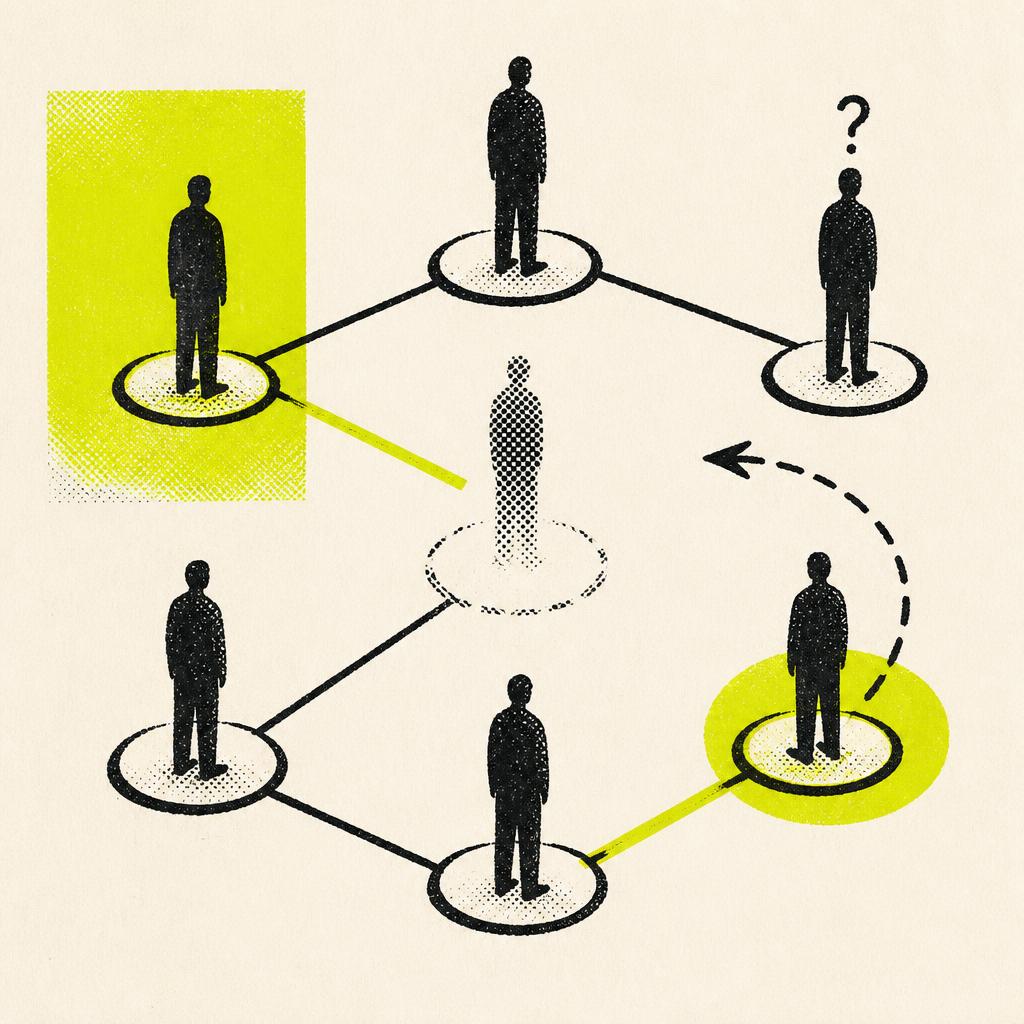
Ryan's deal was in stage four. Three calls with Taylor, the Director of Sales Ops at a company that was, genuinely, a perfect fit. Taylor was engaged. Taylor asked good questions. Taylor said "I'm going to loop in my VP this week." That was two Fridays ago.
Ryan followed up on Monday. Nothing. Followed up Wednesday with a lighter touch. Nothing. The Thursday check-in got a read receipt and silence.
He looked Taylor up on LinkedIn on Friday afternoon.
Taylor was now at a different company. In a different city. Had been for three weeks. The role transition was announced with a photo of Taylor smiling at what appeared to be a going-away party that Ryan was not invited to, which is fair because Ryan barely knew Taylor existed as a person rather than a pipeline vehicle.
The deal was now in the hands of someone who had never heard of Ryan, did not know the product, and was three weeks into a new role with different priorities. Ryan updated the CRM opportunity to "Closed Lost. No Decision" and stared at his pipeline for a while.
Forty percent of deals stall because the primary contact left, changed roles, lost the mandate, or quietly stopped moving the deal forward. Ryan's deal was not unusual. Ryan's deal was just the one he noticed.
Gartner 2024 · LinkedIn State of Sales 2025 · Gong Deal Intelligence, 1.8M opportunities
One contact. Four percent win rate. Four or more contacts. Forty percent. Same deal, same product, same rep. The only variable is how many people at that account understand why this matters and have a stake in moving it forward.
Gong / MySalesCoach
One to four contacts. Four percent to forty percent. Same deal. Same product. Same rep. The only variable is how many people at the prospect company understand why this matters and have a stake in moving it forward.
Taylor Is Only One Of Four Ways Your Champion Disappears
Taylor's story is the most obvious version. New job, new company, dead deal. It is also the least common. The other three ways your champion disappears are quieter, more frequent, and just as fatal to a single-threaded opportunity. If your only defense against losing a deal is that your one contact keeps caring at the same intensity for the entire cycle, you do not have a strategy. You have a coin flip.
All four end the same way. A stage-four opportunity that looked healthy on Monday is a slip on Friday. The only defense that works for any of them is the same defense. More than one relationship at the account, built before you needed it, tied to a business problem that outlives any single person's involvement.
Multi-Threading Is Not Blasting Everyone In The Org
Before the role-by-role breakdown, one thing worth saying clearly. Multi-threading is not blasting everyone in the org. It is not sending the same email to twelve people and hoping one responds. It is building a specific network of relationships around the problem you are solving, so that when Taylor leaves, gets promoted, loses the mandate, or goes quiet, the deal does not leave with them.
The champion stays the champion. You are just making sure they are not the only person who understands why this is a priority, and not the only person whose calendar has to move for anything to happen.
One important nuance from the data. Leading too early with executives drops win rates by six percent. The sequence matters. Build the champion first. Expand to the buying committee around the third touchpoint. If you go to the C-suite before you have a problem fully established at the operational level, you arrive without context and leave without a deal.
"Your champion is your advocate. They are not your deal. The difference matters when their LinkedIn status changes on a Friday afternoon."
The BDR Role. Thread Before The First Meeting.
Multi-threading starts before the first meeting. The handoff is the first opportunity to give the AE more than one name, and almost nobody uses it that way.
"Who else on your team is feeling this?"
That question, asked genuinely and followed with real curiosity, gives the BDR a stakeholder map before the first meeting is even scheduled. It tells the AE who else is in the buying group, who is affected by the problem, and who should be in the room for the first real discovery conversation. A handoff that contains that information is worth dramatically more than one that says "Taylor, Director of Sales Ops, interested in learning more."
Build the map before the meeting
The BDR's job in multi-threading is intelligence gathering. Who else has this problem. Who makes the decision. Who needs to be convinced. Who is the skeptic. That information belongs in the handoff note so the AE walks in with a map, not a hope.
What good looks like
Handoff contains at minimum: the champion, one name above them (economic buyer or their manager), and one name beside them (a peer or end user also affected). Three names minimum. Each with a role, a relationship to the problem, and a note on how they connect to the buying decision.
Expand naturally, protect the champion
The AE's job is to expand the network without making the champion feel bypassed. The fear most reps have is that multi-threading signals distrust. The reality is the opposite. Your champion needs you to multi-thread because they cannot carry the deal alone. They have other priorities, limited internal capital, and zero guarantee they will still be in the role when the contract needs a signature.
What good looks like
By stage two: at least three engaged contacts at the account. Economic buyer has had at least one direct interaction. The champion has been explicitly positioned as the driver, not bypassed, involved. Every deal review includes "who have we talked to and who is still missing from this picture."
Multi-threading is renewal insurance
Single-threaded customers churn at 1.5 to 2 times the rate of multi-threaded ones. If the CSM's only relationship at the account is with the person who bought the product, one departure is all it takes to lose the account to someone starting from scratch with no attachment to the previous decision. Multi-threading in CS is not expansion strategy. It is survival strategy.
What good looks like
By month three: at minimum three active relationships across different levels and functions. Executive sponsor has had a direct touchpoint with the CSM or an executive from your side. The customer's team, not just the buyer, has visibility into the value being delivered. When the champion leaves, someone else at the account already knows your name.
Multi-Threading At Every Stage Of The Deal
Most multi-threading content talks about discovery. The real leverage is knowing what multi-threading looks like at every stage, because the conversation that expands the relationship in week two looks completely different from the one in week twelve when you are waiting for procurement to move.
How To Thread Without Going Around Your Champion
Reps avoid multi-threading because they are afraid of what the champion will think. Which is interesting because the champion is the one who needs you to do it the most.
Your champion is doing your internal selling for you. They are attending meetings you are not in, answering questions you do not know are being asked, and defending a decision that has not been made yet. The rep who only talks to one person is leaving all of that work to one person who has other priorities, limited political capital, and no guarantee they will still be in the role when the deal closes.
The language that works is not "I want to talk to your boss." It is "I want to make sure the people who need to be comfortable with this are part of the conversation before we go further." That positions multi-threading as process, not distrust.
How To Train It. What This Looks Like In Practice.
Most orgs put "multi-thread your deals" in the new hire deck and call it a strategy. The reps nod. They go back to their desks and talk to one person. Nothing changes because nobody ever practiced the actual conversation that surfaces a second contact or asks for the executive introduction. Here is what to actually train.
Back To Ryan
Ryan had met Taylor on three calls. He knew Taylor's challenges, Taylor's goals, Taylor's preferred communication style. He did not know Taylor's manager's name. He did not know who else on Taylor's team was affected by the problem. He did not know if anyone above Taylor had ever heard of Ryan's company or what the business case was.
He found all of this out when Taylor's LinkedIn status changed.
The company still had the problem Taylor described. It was still a perfect fit. The deal that died was the relationship, not the opportunity. And the relationship that died was one person deep in an organization of forty-three people who all had the same problem and none of whom knew Ryan existed.
Multi-threading would not have changed the fact that Taylor left. It would have meant Ryan already knew three other people at that company when Taylor did. And it would have covered him against the other three failure modes at the same time. If Taylor had been promoted, Ryan would have had a warm intro to the successor. If Taylor had lost the mandate, Ryan would have already been working with the person who inherited it. If Taylor had gone quiet, Ryan would have had a second and third thread pulling the deal forward while Taylor got her footing back. The deal would have paused. It would not have died. Those are very different outcomes when you look at a pipeline review.
Champions leave. Champions get promoted. Champions lose their mandate. Champions go quiet. Budget shifts. Reorgs happen. The only variable you control is how many relationships you have built before any of that occurs. One is never enough. It never was.
Keep going
Read next
Close The Gap.
Multi-threading is how the deal survives. GAP selling is how the deal earned the right to exist. The qualification doctrine that pairs with this one.
Free tool
Weekly Coaching Scorecard
The 1:1 rubric that inspects the one question that matters. "Who have we talked to and who is still missing from this picture?"
Outbound, But Smarter
The Modern BDR Operator
Get the next one in your inbox.
New frameworks, hot takes, and playbooks. Written for operators, not audiences.
Subscribe to Booked.