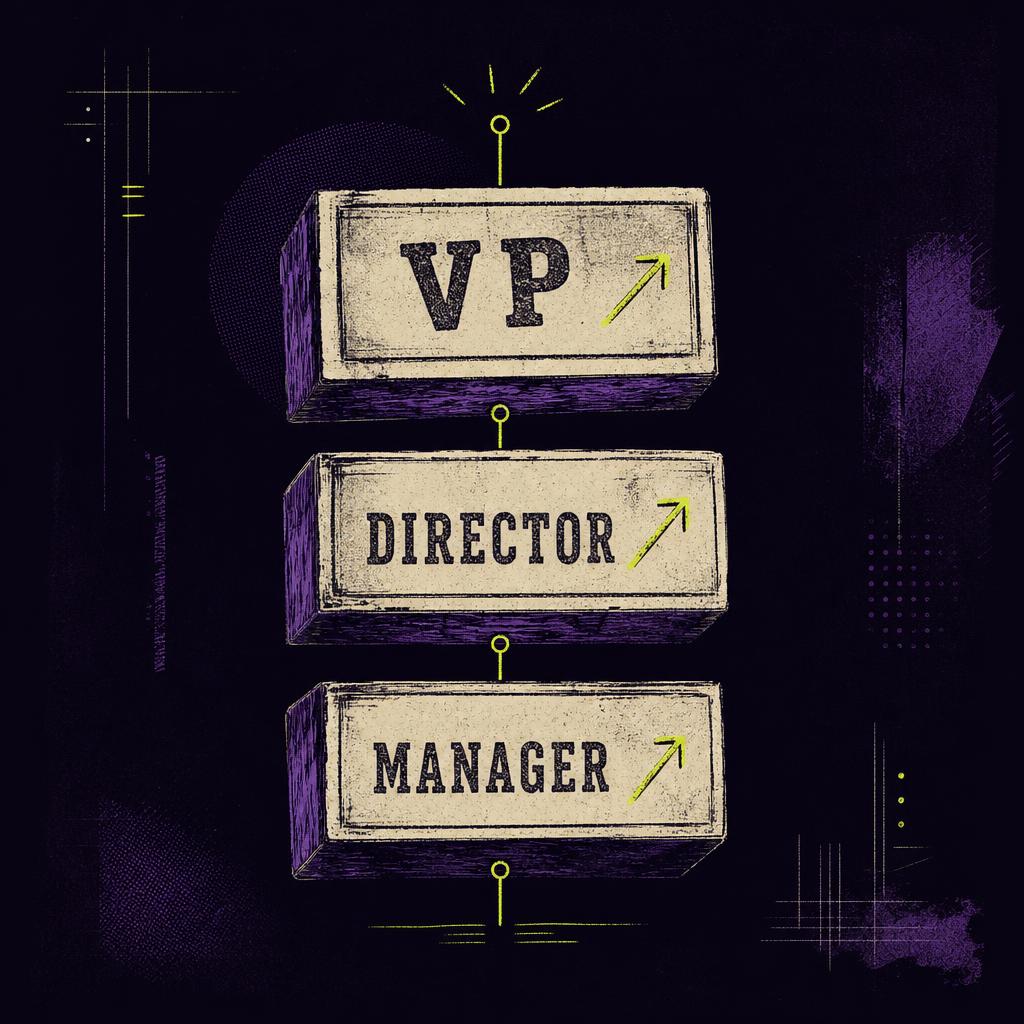
Jordan's first week as Director of Sales Development looked exactly like her last week as Senior Manager.
She jumped into calls. Sat in on 1:1s. Gave rep feedback in the hallway between meetings. Her calendar was full and visible and she was adding value and doing the thing that had always worked. This, she figured, was what showing up looked like.
Her three managers smiled and said nothing.
By week four the reps were going around their managers to get her opinion. Two managers had stopped preparing for their 1:1s with Jordan because she just told them what she saw anyway. Nothing was being built at the system level because Jordan was doing three people's jobs and nobody's job description said "build the operating system."
The part worth saying clearly: they discussed this in the interview. Jordan knew what a Director role required. She said the right things. She believed them. She was also completely confident she could do it, because she had been exceptional at the level below it and exceptional at something adjacent feels like preparation for the thing itself, until it isn't.
What nobody had built in her was the visibility the Director job actually runs on. Different dashboards. Different data. Not meeting volume by rep but Stage 1-to-2 conversion by manager. Not individual quota attainment but ramp velocity by cohort. Not "how did the call go" but "what pattern do I see across my managers' teams that tells me where the coaching gap is." She had never needed to look at those things. She didn't know she was flying blind until she had been flying blind for sixty days.
And here is the thing about the BDR function in 2026: it is not the same job it was eighteen months ago at any level. The motion is shifting. The AI layer is being built in real time. What "good" looks like on a dashboard is still being figured out by the people who are supposed to define it. If you read Your Managers Are Coaching the Wrong Version of the Job, this is the post that sits one level up: it's not just what managers should be coaching, it's what each layer of leadership should be building in the first 90 days to make that coaching land.
That makes the first 90 days harder and more important than it has ever been. Here is what it actually looks like at each level.
MySalesCoach State of Sales Coaching 2026 · 6sense BDR Benchmark, 262 BDRs
Manager / Senior Manager: Days 1 through 90
This is the closest-to-the-work seat. Your leverage is the rep. Your success is individual quota attainment, ramp velocity, and the quality of what your team puts in front of AEs every week. Month one here is not about vision or strategy. It is about knowing your people, your funnel, and exactly where the motion is breaking before you touch anything else.
The temptation at this level is to skip the listen phase and go straight to fixing. You were hired because you know how to run a BDR team. You probably do. But you do not know this team yet, and the rep who looks like a performance problem on paper might be working a territory with garbage data. Audit the context before you audit the people.
Days 1–30. Listen, map, hold cadence.
- 01
Listen to every rep's calls before you give a single piece of coaching feedback.
Know what good and bad actually sound like on your specific team before your mouth opens about it.
- 02
Map the funnel by rep, not as a team average.
Connect rate. Conversation-to-meeting rate. Meeting-to-opportunity rate. A rep with a 6% connect rate and 40% conversation conversion needs completely different coaching than a rep with a 14% connect rate and 20% conversion. Same output. Different problem.
- 03
Find out what your reps actually think the job is.
Not what's in their job description. What they believe they're measured on. That belief is what drives their behavior. If it's wrong, you have an alignment problem before you have a performance problem.
- 04
Understand the data before you trust the data.
Is the CRM clean? Are stage definitions being applied consistently? Is the meeting quality gate real or a rubber stamp? Bad data produces bad coaching. Audit the inputs before you draw conclusions from the outputs.
- 05
Build your cadence and hold it.
Weekly 1:1s that never move. Call reviews that actually happen. Push a 1:1 to Friday and you are coaching the past instead of changing the week in front of you. Block 15-16 hours a week for direct rep development or you are a reporting analyst with a manager title.
Days 31–60. Coach the moment, find the model.
- 01
Coach to specific moments.
Not "you need to create more urgency" but "at the four-minute mark on Tuesday's call you heard her say her team has been managing this manually for eighteen months and you moved to the next question." That level of specificity is what changes behavior. Everything else is feedback the rep files away and forgets.
- 02
Reverse-engineer your top performer.
Opener, objection handling, the follow-up question they ask that nobody else asks. Build a replicable model and coach the rest of the team toward it. Not "be more like Alex" but a specific, observable set of behaviors Alex does that can be practiced.
- 03
Know which rep needs urgency and which needs confidence.
A new hire drowning in cold call anxiety needs completely different coaching than a tenured rep who is coasting. One-size-fits-all coaching is the number one management failure in BDR orgs.
- 04
Start your comp and territory audit.
If quota miss is widespread it is a system design problem, not a rep problem. Territory equity is the invisible variable that makes or breaks performance, and it is almost never talked about until someone leaves over it.
Days 61–90. Ramp model documented, cadence on rails.
- 01
Have a documented ramp model.
What does great look like at day 30, 60, 90 for every new hire cohort, and where is the gap if they're not hitting it. Not a vibes-based sense. Documented benchmarks with a coaching intervention attached to each failure point. The 3-Gate Ramp System is the version I run.
- 02
Your 1:1 cadence runs without you remembering to do it.
It should feel like a system, not an effort. If you are still having to remind yourself to prep for 1:1s by day 90, something is wrong with the structure.
- 03
Answer "which rep is most at risk this quarter and why" without a dashboard.
That knowledge lives in your weekly coaching conversations. If it doesn't, the conversations aren't deep enough yet. The Weekly Coaching Scorecard is the inspection sheet I use to keep them at that depth.
Director / Senior Director: Days 1 through 90
The biggest transition in BDR leadership. Your lever is no longer the rep. It is the manager. And this is where most people, including Jordan, walk in knowing that intellectually and then immediately start doing the job below them because it feels real and the new job feels like it hasn't started yet.
The new visibility you need does not arrive automatically with the title. You have to build it. Stage 1-to-2 conversion by manager. Ramp velocity by cohort. Pipeline trends that tell you which manager's team is quietly plateauing three weeks before it shows up in the forecast. These are the dashboards that run the Director job. If you are not looking at them you are guessing. And if you are filling that gap by going back to rep-level work, you are undermining your managers without realizing it.
Days 1–30. Shadow, map by manager, build the relationships.
- 01
Shadow your managers' 1:1s.
Not to evaluate the reps but to understand how your managers coach. What are they inspecting? What questions do they ask when a rep misses quota? Are they running pipeline reviews dressed up as coaching sessions? That distinction is the whole job at this level.
- 02
Map the funnel by manager.
If one manager's team converts meetings to opportunities at consistently higher rates, that's a coaching best practice worth naming and spreading. If one manager's reps all plateau at month six, that's a manager development problem, not six simultaneous rep problems wearing the same costume.
- 03
Ask the uncomfortable follow-up question.
The first answer in any listening tour is the polite version of the truth. "What's not working?" gets you the safe answer. "Why hasn't that been fixed yet?" gets you the actual information.
- 04
Build the cross-functional relationships your job runs on.
AE leadership (what does the handoff quality look like from their side), RevOps (what does the funnel data say that your dashboards might be obscuring), Marketing (what is the ICP signal quality and how does it affect rep activity). At this level your job is as much relational as operational.
- 05
Pick two or three things that, in 60 days, would move the number most.
Share them with your skip-level. Then deliver them. That is how you earn the trust to build the bigger thing.
Days 31–60. Build the operating rhythm. Build the dashboards.
- 01
Stand up the operating rhythm.
Weekly manager sync, monthly calibration, quarterly planning. This cadence is the system that makes your team's performance predictable. Without it you are managing by exception and fire, not by design. The Leadership Operating Rhythm is the template.
- 02
Your 1:1 with each manager is a coaching conversation about how they coach.
Not a status update, not a pipeline review. Those are separate meetings. "What does your team need right now and do you have the skill to deliver it" is the question that runs a Manager 1:1 at the Director level.
- 03
Define what great management looks like at your company.
In language specific enough that every manager on your team could describe it the same way. If they give you three different answers, you have not built the standard yet. That is month two's work.
- 04
Get the new dashboards built. Now, not later.
Stage 1-to-2 by manager. Ramp velocity by cohort. Meeting-to-opp rate by manager and rep vintage. These are the instruments your job runs on. If they don't exist yet, build them. You cannot coach what you cannot see.
Days 61–90. Managers run themselves. Standard ships.
- 01
Your managers run their 1:1s without you in them.
If you are still sitting in to make sure they happen, the managers are not yet accountable for them. That is a development gap to close, not a permanent arrangement to accept.
- 02
Your team can recite what great management looks like here.
Not a document. A shared operating standard that lives in how your managers show up every week.
- 03
Ship v1 of the operating rhythm with early data.
Not perfection. A direction, with evidence that it is working. Month three is about proving you can build something, not that you have built everything.
VP of Sales Development: Days 1 through 90
The VP job is where the first 90 days is least about doing and most about listening, aligning, and earning the trust of the people who will need to execute whatever you design. The VP who rewrites the org in month two hasn't done the work that earns the right to rewrite it. The org will comply and quietly work around them, usually in ways that don't show up until the forecast is due.
At this level your primary relationships are not with your directors. They are with the CRO, the CFO, the regional VPs of Sales, and the CMO. The first conversation you need with each of them is not about pipeline strategy. It is about what they need to trust you. Those are different conversations and most new VPs skip the second one.
Days 1–30. Political landscape, mandate, org audit.
- 01
Listen for politics and history first.
What has been tried, why it did not work, who the internal skeptics are and whether they are skeptical for good reasons. You get that from the CRO, the regional VPs of Sales, and a few well-chosen director conversations before you have a single opinion in public.
- 02
Agree with your CRO on three things before day 30.
What success looks like at six months in measurable terms. What decisions you own vs what requires their sign-off. What the function is supposed to contribute that it currently is not. Document it. Ambiguity at the VP level is expensive and the cost shows up six months later when everyone has a different memory of the original conversation.
- 03
Do the full org design audit before you touch a single person.
Manager-to-rep ratios, territory design, ICP definition, tech stack, comp plan, BDR-to-AE promotion rate, ramp benchmarks by region. The VP who restructures in month two without this audit restructures again in month six. The BDR Org Design Teardown is built for exactly this.
- 04
Talk to AE leadership early and specifically.
Ask what they receive from BDRs and what they actually need. Ask what percentage of BDR-sourced meetings they accept and why they reject the ones they do. Fifteen minutes is a complete diagnosis of handoff quality.
- 05
Build the AI strategy early.
Not a tool list. A philosophy. What the function automates, what it augments, and what stays human. Orgs running AI as a productivity layer for research and CRM hygiene while keeping human judgment in discovery are outperforming the ones who automated outreach and called it a transformation.
Days 31–60. POV on org design. Measurement framework. Career path.
- 01
Articulate the org design POV. Don't implement it yet.
What needs to change, in what sequence, and why. Share it with your CRO before you share it with your team. The VP who surprises the CRO with a restructure has misunderstood who their primary stakeholder is.
- 02
Build the measurement framework before the enablement.
BDR-sourced pipeline as a % of total. AE win rate on BDR-sourced opportunities. Time-to-first-qualified-opportunity by hire cohort. BDR-to-AE promotion rate. Cost per sourced ARR. These are the metrics that earn the function's budget.
- 03
Start the career path conversation publicly.
The BDR-to-AE promotion rate is a talent brand metric and a retention lever simultaneously. If it is unclear or low, your best reps leave before you can develop them. Make it visible. Track it as a success metric from month two.
- 04
Identify the regional differences in your motion.
NA, EMEA, and APAC are not the same market with different time zones. Know where to standardize (ICP, qualification, handoff standard, measurement) and where to adapt (channel mix, cadence, compliance, local proof).
Days 61–90. Defend in a boardroom. Ship v1 of the framework.
- 01
Defend the BDR-sourced number and the org design with no prep.
Not because you memorized a deck. Because you spent 90 days building the understanding that makes the defense credible. If you can't yet, you need 30 more days of listening before you start building.
- 02
Ship v1 of the operating framework.
A measurement standard. A manager development model. A handoff quality definition the AE team has seen and agreed to. Something that proves you can build in this org before you ask for the budget to build more.
- 03
Establish the GTM leadership relationship.
The VP who speaks pipeline and business impact at the revenue leadership table earns a seat at future strategic conversations. The one who reports activity metrics in a room full of revenue leaders quietly loses influence every quarter.
The Listening Tour Questions Most Leaders Skip
Every good new leader does a listening tour. Most ask "what's working and what isn't" and get the polite version of the truth. The questions below get the real version. They're different at each level because you're listening for different things.
Manager. Ask reps and peers in the first 30 days.
- 01
If you could change one thing about how we run outbound this week, what would it be?
Not last quarter. This week. Forces a specific operational answer instead of a strategic wish list.
- 02
What does your best rep do differently than the rest of the team?
If they can't answer in specific behavioral terms, the coaching here is not differentiated enough to close the gap.
- 03
What's in the CRM that you don't actually trust?
Data integrity problems hide performance problems. You need to know before you start coaching from the data.
- 04
When did you last listen to a call that made you genuinely proud?
If they have to think for a long time, that tells you something. If they pull one up immediately and play it, that tells you something else entirely.
Director. Ask managers and cross-functional partners.
- 01
What does great management look like on this team right now, and who is closest to it?
If they all point to the same person, you have one strong manager and a development problem.
- 02
Where is the funnel leaking, and is it the same leak across every manager or different ones?
Consistent leaks are system problems. Different leaks by manager are coaching problems. They require completely different interventions.
- 03
What has AE leadership said about handoff quality in the last quarter?
Ask for the exact words if you can get them. The polished version and the actual version are usually different conversations.
- 04
Why hasn't that been fixed yet?
The follow-up to every answer. The most useful question in any listening tour and almost nobody asks it.
VP. Ask the CRO, regional VPs, and AE leadership.
- 01
What is the CRO's honest assessment of what the BDR function contributes versus what it should?
If they've never been asked to articulate this directly, the function has never had a clear mandate. That is your first project.
- 02
What percentage of closed ARR traces back to BDR-sourced pipeline, and where does leadership want it?
If they don't know the first number, the function is not being measured as a revenue driver. If they don't know the second, there is no target to build toward.
- 03
What is the AE win rate on BDR-sourced opportunities versus inbound?
The single most honest measure of whether BDRs are qualifying or just generating meetings. Most orgs don't track it. The ones that do either love or hate the answer.
- 04
What would need to be true for you to double the BDR headcount?
The answer tells you exactly what the function needs to prove and what the ceiling on investment is. Build toward that answer from day one.
The AE Leadership Relationship at Every Level
The BDR function earns or loses its credibility in the AE relationship. Not in the QBR. Not in the pipeline review. In the specific quality of what BDRs hand AEs every week, and whether AEs trust it enough to show up prepared. That relationship looks completely different at each level, and most BDR leaders underinvest in it at every altitude.
What it's about at each level
- Manager: handoff quality at the rep level. Run a monthly handoff review with your AE counterpart. Five meetings. Open the notes together. Ask if they could have run a relevant demo from what was there.
- Director: qualification standard alignment. Agree with AE leadership on what "qualified" actually means and build that definition backward into the BDR motion. Quarterly at minimum.
- VP: co-owning the sourced pipeline number. Present BDR-sourced pipeline to the CRO alongside the VP of Sales as a joint revenue contribution with a shared AE win rate metric.
What breaks without it
- AEs stop preparing for BDR-sourced meetings. Discovery restarts from zero every time. The meetings convert at half the rate they should and everyone blames the BDR team.
- BDRs and AEs operate with different definitions of a good meeting. BDRs hit quota. AEs reject the pipeline. Nobody agrees on why. This conversation happens in your QBR instead of before it.
- The function becomes a cost center the CRO tolerates rather than a revenue driver they invest in. The next headcount conversation goes badly.
AI Fluency at Each Level. Not the Same Answer.
The BDR function in 2026 is mid-transformation and AI is the variable that changes everything downstream. But AI fluency does not mean the same thing at every level. A Manager asking "which AI tool should my reps use for research" and a VP asking "what is our AI adoption strategy and how do we measure it globally" are having completely different conversations about the same subject. Both matter. Neither is the other. The full breakdown lives in Most BDR Teams Don't Need More AI; here's the short version by altitude.
Manager. AI at the rep level.
- 01
Account research compression.
A rep spending 40 minutes researching an account before a cold call is not adding more value than a rep who gets that brief in four minutes from an AI-assisted workflow and spends the other 36 minutes calling. Fastest win in AI adoption.
- 02
Call review efficiency.
AI surfaces the moment on a call worth coaching before your manager listens to the full recording. Not a replacement for the conversation. A way to make it more targeted.
- 03
Rep-facing signal identification.
Train reps to use AI to identify the signal before they write the email, not to write the email without one. The signal is the skill. The draft is just efficiency. Start with the BDR Prompt Library.
- 04
What to keep human.
The cold call. The discovery conversation. The moment a prospect says something real and the rep has to decide what to do with it. Coach AI adoption hard on the research and admin side. Protect human judgment on the conversation side.
Director. AI at the manager and system level.
- 01
Cohort trend analysis.
A Director manually pulling Stage 1-to-2 conversion data by manager and rep vintage every week is spending time on work AI should be doing. Build the dashboard that surfaces it automatically and spend the saved time coaching.
- 02
Call pattern analysis at scale.
Four managers each overseeing eight reps means you cannot listen to every call worth listening to. AI surfaces the ones where something interesting happened. Use it to decide what to share across the team and what to address individually.
- 03
Meeting quality scoring.
Build an AI-assisted rubric that scores handoffs against the standard you defined. Not to replace manager judgment. To give managers a consistent starting point and shared language for what good looks like.
- 04
Spot the plateau before the forecast.
The quietly underperforming manager's team shows up in lagging indicators weeks after a Director with the right visibility would have caught it. AI-assisted pipeline signal detection gives you the leading indicator.
VP. AI as a strategic function decision.
- 01
Build the philosophy before the stack.
The VP who arrives and immediately buys five AI tools has skipped the most important question: what problem are we solving and which layer does it live in. Productivity first. Coaching augmentation second. Operational intelligence third. Skipping to layer three without layer one creates adoption problems that are very hard to reverse.
- 02
The adoption measurement problem.
Most orgs measure AI adoption by tool login rate. That's activity measurement dressed up as strategic measurement. A rep who logs in and generates a brief they never read has not adopted AI. Measure the behavior change, not the login.
- 03
The governance question nobody talks about.
What happens when reps use AI badly at scale. Generic AI-generated emails at volume. Hallucinated account details in handoff notes. An AI-assisted objection handler that contradicts your positioning. These are real risks and they are the VP's problem to prevent. Build the governance layer before the adoption program, not after something goes wrong.
- 04
Present AI to the CRO in ARR terms.
"Our reps are 40% more productive" is an interesting internal metric. "AI-enabled output reduced our cost per sourced ARR by 22% while headcount stayed flat" is a board-level argument for continued investment. Know which version you're telling and to whom.
"The first 90 days doesn't just set your reputation. It sets the ceiling for everything you build after it."
What Transfers Between Levels, and What Doesn't
At Director level
- Rep coaching instinct: becomes a liability if you use it directly. Transfer it into how you develop your managers instead.
- Pipeline inspection: still critical, but now you look by manager and cohort, not by rep.
- Operating cadence: your most important new skill. The system that makes good management repeatable across your team.
- Data fluency: expands from rep metrics to manager-level patterns and funnel trends by cohort.
- Cross-functional relationships: becomes essential. Your AE partnership and RevOps relationship are core to the job now.
- Talent instinct: redirects from reps to managers. How do you develop the people who develop the people?
At VP level
- Rep coaching instinct: nearly irrelevant at this altitude unless you're diagnosing a systemic breakdown.
- Pipeline inspection: becomes a board-level narrative: BDR-sourced ARR, AE win rate on sourced opps, cost per pipeline dollar.
- Operating cadence: expands to org-wide rhythm and how the function reports to GTM leadership quarterly.
- Data fluency: expands again to contribution metrics: sourced pipeline mix, AE win rate, promotion rate, cost per ARR.
- Cross-functional relationships: becomes your primary lever. The VP without CRO trust does not keep the budget.
- Talent instinct: becomes org design. Career path, promotion pipeline, talent brand, hiring model.
The Thing That Makes All Three Work
The best BDR leaders I have worked with and alongside at every level share one capability: they can zoom in and zoom out in the same week without losing their footing at either end.
A VP who can sit in a call review on Tuesday and give specific feedback on the exact moment a rep lost a prospect's attention, then present BDR-sourced pipeline strategy to the board on Thursday, is not doing two different jobs. She is demonstrating that she understands the work at every altitude. Which is why the board believes the strategy and the reps believe she knows what she is talking about.
The zoom-in capability does not mean doing the work at the level below you. It means understanding it well enough to diagnose it, speak to it credibly, and make the decisions that connect to it. A VP who cannot articulate why a manager's Stage 1-to-2 conversion is low at the behavior level cannot build a credible strategy to fix it at the org level. The leaders who hold both ends of the thread are the ones who actually move the number.
Back to Jordan
She figured it out around day seventy. Not because someone told her. Because she looked at her calendar and realized she had not had a single conversation about what the operating system should look like. She had been too busy being the best manager on the team to build anything above it.
She cleared two days. Pulled her three managers into a room. Asked each of them what they needed to do their jobs better, not what was wrong with their reps, what did they actually need. It was, by her own account, the most useful conversation she had in her first ninety days and it happened on day seventy-two.
The framework got built in month four. It was good. It would have been better in month one and they both knew it. The managers who felt undermined in January were more willing to adopt something in April, but not as willing as they would have been if Jordan had built it with them from day one.
That gap does not go away. It just gets smaller. And the leaders who minimize it are almost always the ones who were honest about which job they actually had before they started doing it.
Know which level you are at. Build the visibility that level actually requires. And leave the job below you to the person you hired to do it, even when you are better at it than they are. Especially then.
Keep going
Read next
Your Managers Are Coaching the Wrong Job.
Once you know what each level should be building, here's what to coach toward inside it.
Free tool
BDR Org Design Teardown
Pick your stage and ACV. Get the org chart, ratios, comp, tooling, and the next 3 hires in order. Built for the audit in days 1–30.
Outbound, But Smarter
The Modern BDR Operator
Get the next one in your inbox.
New frameworks, hot takes, and playbooks. Written for operators, not audiences.
Subscribe to Booked.